
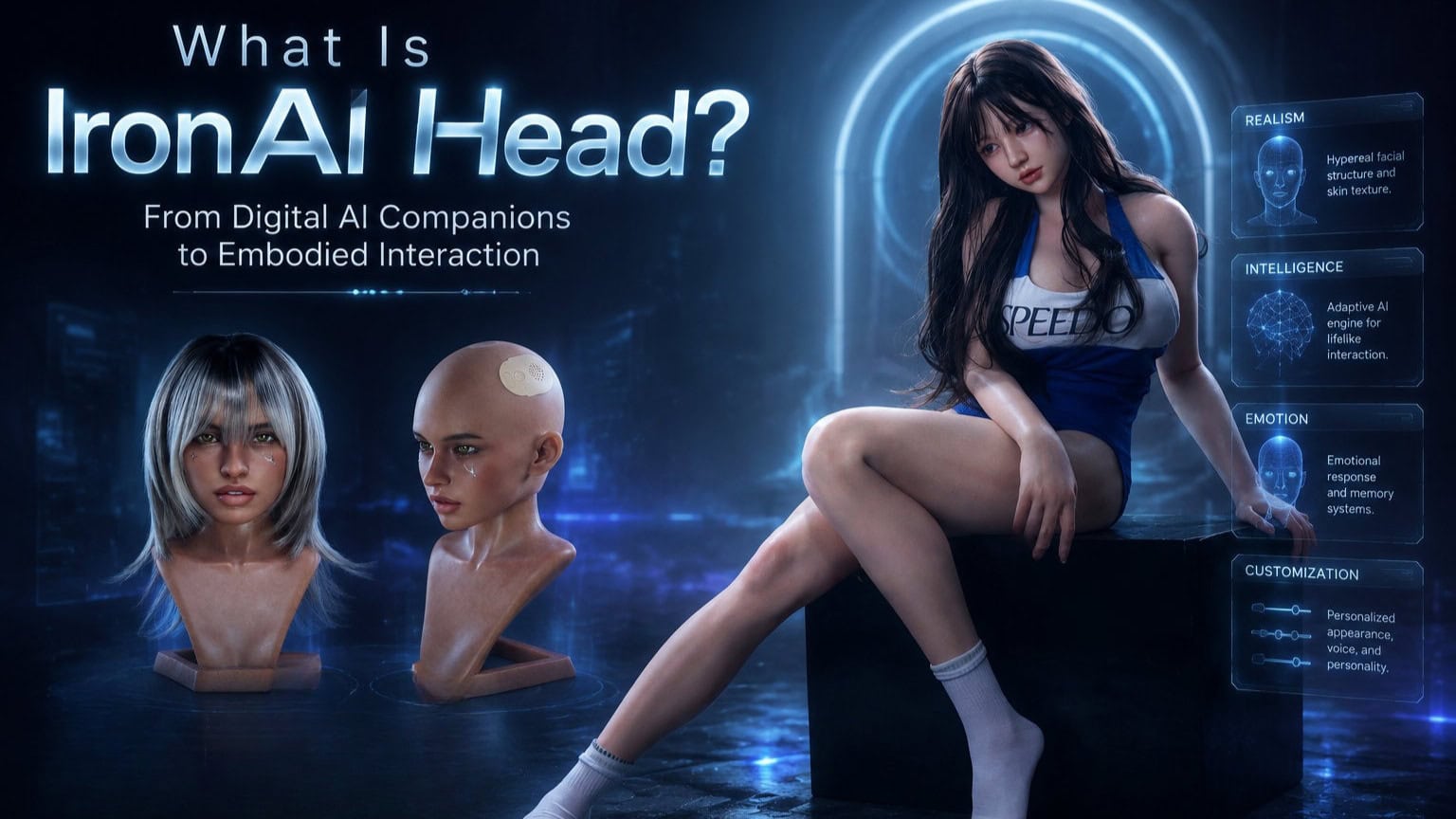
What Is IronAI Head? From Digital AI Companions to Embodied Interaction
1. Introduction — Why IronAI Matters Now
Over the past few years, artificial intelligence has rapidly expanded from a technical tool into something far more personal: a conversational companion.
From mobile chat applications to voice-based assistants, AI systems are increasingly designed not just to respond to commands, but to simulate presence, continuity, and emotional interaction. In other words, AI is no longer only about information—it is about relationship-like interaction patterns.
However, despite this evolution, most AI companions remain confined to screens. They exist as text boxes, voice interfaces, or mobile applications—intelligent, but disembodied.
IronAI Head emerges at this exact intersection: where conversational AI begins to move beyond the screen and into a physical form factor.
It does not claim to redefine artificial intelligence itself. Instead, it represents a more specific shift:
the transition of AI companionship from digital-only systems into embodied, physical interaction layers.
This shift raises an important question:
What happens when AI companionship is no longer something you open—but something that exists in your physical environment?
IronAI Head is one early answer to that question.
2. The Evolution of Companion Dolls — From Physical Realism to Interaction Systems
To understand IronAI Head, it is necessary to look at how companion dolls have evolved over time.
The first generation of modern dolls focused almost entirely on physical realism. Materials, skin textures, facial sculpting, and anatomical accuracy became the primary benchmarks of quality. The goal was to replicate appearance and tactile experience as closely as possible.
Later developments introduced functional enhancements—internal skeleton structures (EVO skeleton is now the mainstream) , heating systems, and more dynamic physical features. These improvements increased realism in interaction capability, but the core experience remained largely passive.
The user could touch, position, and observe—but not truly engage in ongoing interaction.
At the same time, a separate technological ecosystem was developing in parallel: AI companion applications. These systems introduced conversational continuity, memory simulation, and emotional response modeling. However, they remained entirely digital, constrained to screens and audio interfaces.
This created a structural gap:
- Physical dolls had presence, but no interaction intelligence
- AI companions had intelligence, but no physical presence
IronAI Head is positioned precisely at the intersection of these two trajectories.
It does not replace either category. Instead, it functions as a bridge layer between physical companionship and conversational intelligence.
In this sense, it represents not a finished category, but a transitional one.
3. What Is IronAI Head — A Physical Layer for Conversational AI
IronAI Head is an embedded intelligent voice and text interaction module designed for compatible companion doll heads.
Unlike external “chatbox-style” add-ons or purely app-based systems, IronAI Head is physically integrated into the doll structure. Once installed, the module remains hidden inside the head cavity, fully concealed beneath hair and exterior design elements.
From the user’s perspective, the system operates in a simple way:
- The module is installed inside the head
- It connects to a mobile application via Wi-Fi
- The system is paired and activated
- Conversation can begin through voice or text interaction. You can even activate her by shaking her.
The key design principle is integration without visual disruption. The device does not alter the external appearance of the doll, maintaining full aesthetic continuity while enabling interactive functionality.
Functionally, IronAI Head supports:
- Real-time voice conversation
- Text-based chat via mobile application
- Context-aware dialogue continuity
- Cloud-based AI processing for stable interaction
Importantly, it is not designed as a robotics system. It does not control body movement or physical gestures. Instead, its focus is strictly on conversational presence—turning static physical form into an interactive communication interface.
4. Context Shift — Why IronAI Is Different From Traditional “Chat Devices”
At a surface level, IronAI Head may appear similar to existing AI voice devices or chatbot systems. However, its positioning is fundamentally different in context and application.
Traditional AI chat systems are designed as standalone interfaces. Users engage with them through phones, computers, or smart speakers. The interaction is always external to the user’s physical environment.
IronAI Head introduces a different configuration. It embeds conversational AI into a persistent physical object that is already part of the user’s space. This creates a new type of interaction dynamic:
- The AI is not “opened”
- The AI is “present”
This shift may seem subtle, but it changes the structure of engagement. Interaction becomes less about initiating a session and more about responding to presence.
At the same time, it is important to be precise about its current limitations.
IronAI Head is not a fully autonomous AI companion system. It does not possess independent agency, mobility, or real-world awareness beyond its designed conversational scope. Its intelligence is derived from cloud-based models and remains constrained to dialogue interaction.
In this sense, it should be understood as an early-stage embodiment of conversational AI, rather than a complete realization of artificial companionship.
It represents progress, but not completion.
5. Core Experience Layer — How Interaction Actually Feels
IronAI Head is not defined by a single feature, but by a layered interaction structure. Instead of treating conversation as a simple input–output process, the system is designed around three overlapping experience layers: conversation continuity, emotional adaptation, and memory-based familiarity.
These layers are not presented as separate functions during use. From the user’s perspective, they appear as a single continuous behavior: the system “feels” increasingly responsive and familiar over time.
5.1 Natural Conversation Layer — Continuous, Interruptible Dialogue
At its core, IronAI is built to support uninterrupted conversational flow.
Unlike traditional scripted systems that rely on predefined response paths or fixed command structures, IronAI uses a context-aware dialogue engine that allows conversation to evolve naturally.
This creates several key interaction characteristics:
- Conversations do not reset after each exchange
- Topics can shift without explicit commands or mode switching
- Users can interrupt or redirect the dialogue at any time
- Responses are generated in real time based on conversational context
This structure reduces the sense of “system interaction” and replaces it with something closer to ongoing dialogue behavior.
In practice, the system is not waiting for commands—it is maintaining continuity.
The intention here is not to simulate perfection, but to reduce friction in communication, allowing interaction to feel less segmented and more fluid over time.
5.2 Emotional Interaction Layer — Context-Sensitive Response Behavior
Beyond linguistic understanding, IronAI incorporates an emotional response model that influences tone, pacing, and conversational style.
Rather than treating all inputs equally, the system adjusts its responses based on contextual signals within the dialogue. These include phrasing patterns, conversational continuity, and user interaction style.
As a result, the same system may respond differently depending on how the conversation evolves.
For example:
- In casual dialogue, responses tend to be lighter and more conversational
- In more emotionally charged contexts, tone shifts toward attentiveness and stability
- In longer interactions, the system gradually adapts to the user’s communication rhythm
This does not imply human-like emotion or consciousness. Instead, it refers to structured variation in response behavior designed to support perceived conversational depth.
The goal is not emotional simulation in a literal sense, but interaction consistency that avoids mechanical repetition.
5.3 Memory Layer — Building Familiarity Over Time
One of the defining components of IronAI is its ability to retain selected conversational context across sessions.
This memory system does not function as full historical replication of all conversations. Instead, it selectively stores interaction-relevant information such as:
- User preferences expressed during conversation
- Recurring topics or themes
- Communication style tendencies
- Previously established conversational context
Over time, this creates a continuity effect where interactions do not feel isolated.
Instead of starting from zero in every session, the system gradually builds a structured familiarity profile.
This results in a subtle but important shift in user experience:
- Early interactions feel exploratory
- Later interactions feel increasingly consistent
- Long-term use develops recognizable conversational patterns
From a design perspective, this memory layer is intended to support relationship continuity simulation, not data accumulation.
It is not about storing everything—it is about preserving what matters for ongoing interaction quality. AI Companion Lab proposed a structured theoretical model called the “AI Companionship Lifecycle” in The AI Companionship Lifecycle: A Structural Theory of How Human–AI Companion Relationships Begin, Evolve, and Stabilize, which systematically explains how the relationship between humans and AI companions begins, evolves, and stabilizes. In this article, we propose a structured theoretical model called the “AI Companion Lifecycle,” which systematically explains how the relationship between humans and AI companions begins, evolves, and stabilizes. Interested users can visit our AI Companion Lab to read more researches on AI companion.
5.4 Multi-Language Interaction Layer — Global Accessibility
IronAI supports multi-language switching across seven major languages, including English, Chinese, Japanese, French, German, Spanish, and Korean.
Rather than treating language as separate modes, the system is designed to handle language as part of continuous dialogue context. Users can switch languages during conversation without restarting the interaction session.
This allows the system to maintain conversational continuity even in multilingual environments, which is particularly relevant for global users who may naturally shift between languages in daily communication.
5.5 Experience Summary — From Function to Perception
When these layers operate together, IronAI Head does not present itself as a collection of features.
Instead, it produces a unified behavioral impression:
- Conversations feel continuous rather than segmented
- Responses feel adaptive rather than static
- Interaction feels increasingly familiar over time
It is important to emphasize that this is not achieved through artificial personality modeling alone, but through the combination of dialogue continuity, contextual response variation, and structured memory retention.
In other words, IronAI does not attempt to simulate a “complete entity.” It constructs a progressively familiar interaction system within clearly defined technical boundaries.
6. Hardware & System Architecture — Stability Behind the Interaction
While IronAI Head is experienced primarily as a conversational system, its performance is grounded in a compact hardware architecture designed to support continuous, low-friction operation inside a physical doll head.
Unlike external smart speakers or standalone devices, the system must operate under strict spatial, thermal, and acoustic constraints. This shapes its design philosophy: integration first, visibility zero.
6.1 IronAI Core — Embedded Processing Unit
At the center of the system is the IronAI Core module, which functions as the processing and communication hub.
It is responsible for:
- Managing real-time voice interaction requests
- Handling Wi-Fi connectivity and cloud communication
- Coordinating app pairing and device authentication
- Executing firmware-level system control
The Core is designed to remain fully concealed once installed, ensuring that no part of the hardware interferes with the external aesthetics of the head sculpture.
This separation between visible form and internal system is intentional: the doll remains visually unchanged, while intelligence operates invisibly beneath the surface.
6.2 Connectivity & Cloud Processing — 2.4GHz Wi-Fi Architecture
IronAI Head operates through a 2.4GHz Wi-Fi connection, enabling stable communication with its cloud-based AI engine.
This architecture allows:
- Low-latency voice transmission
- Continuous conversational context handling
- Remote model updates without hardware replacement
- App-based account synchronization
Importantly, the system does not require the mobile application to remain open during daily voice interaction. Once paired, the device can operate independently within the network environment.
This reduces friction in daily use and supports a more natural interaction rhythm.
6.3 OTA Update System — Designed for Iteration, Not Finality
One of the defining structural decisions behind IronAI is its update-first design.
Through OTA (Over-the-Air) firmware updates, the system can continuously evolve after deployment.
Updates may include:
- Conversation model improvements
- Stability and latency optimizations
- Memory behavior refinements
- Feature expansion within the existing architecture
This positions IronAI not as a static product, but as a continuously evolving interaction system.
In practical terms, the user experience is expected to change over time—not through hardware replacement, but through software iteration.
7. Installation & Everyday Use — From Setup to Daily Interaction
One of the design priorities of IronAI Head is accessibility. The system is intended to be installed and activated without technical expertise, making the transition from unboxing to interaction as direct as possible.
7.1 Simple Setup Flow
The installation process is structured into a short sequence:
- Install the IronAI mobile application
- Connect the IronAI Core module to 2.4GHz Wi-Fi
- Pair the device through the application interface
- Insert the module into the designated space inside the head
- Place the wig to fully conceal the system and complete installation
Once completed, the system is ready for conversational use. No additional calibration or configuration is required for basic operation. You can check the video guide below to setup your your companion doll.
7.2 Everyday Interaction — App and Voice Modes
IronAI supports two primary interaction modes:
Voice Interaction:
Users can speak directly to the doll head once the system is activated. The conversation is processed in real time, with responses delivered through the embedded audio system.
The experience is designed to feel immediate, without requiring command phrases or structured prompts.
Text Interaction (App-Based):
In parallel, users can engage with the system through the mobile application. This mode allows:
- Text-based conversation history
- Memory review and synchronization
- Conversation management and preferences adjustment
Importantly, text interaction remains available even when the device is offline, ensuring continuity of communication across different usage conditions.
7.3 Sleep & Wake Behavior — Natural Transition States
To support a more organic interaction rhythm, IronAI includes an automatic sleep mode when inactive.
In sleep state, the system reduces active processing while maintaining readiness for reactivation.
Users can resume interaction through:
- Gentle physical interaction (shake-to-wake behavior)
- App-based activation
- Voice initiation after system readiness
This avoids the need for explicit power cycling or rigid activation commands.
8. Ethical & Conceptual Positioning — Understanding IronAI in Its Current Stage
As conversational AI begins to move into physical form factors, it is important to position IronAI Head accurately within its current technological and social context.
IronAI is not a fully autonomous artificial companion system, nor is it intended to simulate independent consciousness or human-like agency. Instead, it should be understood as an early-stage embodiment of conversational AI within a physical object environment.
This distinction matters for two reasons:
First, the system remains fundamentally constrained by current AI architectures. Its intelligence is derived from cloud-based models and is limited to conversational interaction. It does not perceive the physical world, control movement, or operate beyond its defined communication scope.
Second, the environment in which such technologies can evolve is not purely technical. It is also shaped by social expectations, ethical boundaries, and regulatory frameworks. As a result, embodied AI is likely to develop unevenly across different industries and use cases.
In this context, IronAI represents a transitional form rather than a final product category.
It reflects a broader reality:
AI companionship is advancing faster in software than it is in physical embodiment.
IronAI exists at the intersection of that imbalance.
9. Adult Industry as an Early Structural Layer
While AI companionship is often associated with mainstream technology platforms, physical embodiment introduces additional constraints related to acceptance, distribution, and regulation.
Because of this, certain forms of experimentation tend to emerge earlier in adjacent industries where physical products already exist.
In this case, the companion doll industry provides an infrastructure where physical AI integration can be tested in a controlled and specialized context.
This does not define the direction of AI companionship as a whole, but it does explain why early embodied systems may appear in non-mainstream channels before broader adoption occurs elsewhere.
IronAI should therefore be viewed as part of a distributed experimentation phase, rather than a finalized direction for AI companions.
10. BreathyDoll Positioning — Companionship as a Design Principle
For BreathyDoll, the introduction of IronAI is not simply a product extension. It aligns with a broader design philosophy: the idea that companion dolls should be understood as interaction-based entities rather than static objects.
Traditional perspectives often reduce dolls to either aesthetic objects or functional products. However, as interaction technologies evolve, this framing becomes increasingly limited.
From a conceptual standpoint, BreathyDoll views companionship through three layers:
- Physical presence (form and realism)
- Emotional perception (how interaction is experienced)
- Conversational continuity (how interaction evolves over time)
IronAI introduces a new layer into this structure: responsive communication.
However, it is important to remain precise in positioning.
IronAI does not transform companion dolls into autonomous companions. Instead, it extends their interaction boundary by adding conversational capability.
In this sense, the philosophy remains consistent: Companion dolls are not tools. They are designed interaction mediums that evolve with technology.
This framing avoids overstating capability while still acknowledging directional evolution.
11. Multi-Brand Release — Real Lady, Irontech, and Sigafun IronAI Heads
IronAI Head is not limited to a single brand implementation. It is being introduced across multiple companion doll brands within the same manufacturing ecosystem, including:
- Real Lady
- Irontech
- Sigafun
These brands operate under a shared technological foundation, while maintaining distinct design languages and product aesthetics.
The IronAI system serves as a unified interaction layer that can be integrated across different head sculpt designs and product lines. This allows the same conversational architecture to be deployed in varied visual and stylistic contexts.
From a user perspective, the core interaction system remains consistent:
- Voice and text-based AI conversation
- Memory-enabled interaction continuity
- Multi-language support
- Cloud-based response processing
However, the visual and physical expression of each doll head may differ depending on brand-specific design choices.
This multi-brand deployment reflects an important structural direction:
AI interaction systems are becoming modular layers rather than isolated products.



12. Future Outlook — From Conversational Systems to Embodied Interaction Layers
IronAI Head represents a starting point, not a destination.
At present, AI companionship is primarily defined by conversational systems. These systems operate through text or voice interfaces and rely on external devices for access.
The introduction of physical embodiment creates a new trajectory:
- From app-based interaction → to environment-based presence
- From session-based conversation → to continuous availability
- From abstract identity → to contextual physical anchoring
However, this evolution will not be linear or uniform. It is more likely to progress through incremental stages:
- Improved conversational intelligence
- Persistent memory and personalization
- Multi-modal interaction (voice + physical systems)
- Partial embodiment in controlled environments
- Broader integration into physical companion systems
IronAI belongs to the early phase of this sequence. It does not claim to represent a mature AI companion, but rather a visible early structure of a much longer technological transition.
As AI systems continue to evolve, the boundary between digital companionship and physical interaction will gradually blur. However, that boundary is not disappearing quickly—it is being negotiated step by step through systems like IronAI.
Conclusion
IronAI Head should be understood less as a finished product and more as a functional prototype of embodied conversational interaction.
It sits at a point where three domains overlap:
- AI language systems
- Physical companion design
- Emerging interaction philosophy
Its significance lies not in completeness, but in direction.
It indicates that conversational AI is beginning to move beyond screens, and that physical form factors may become part of its next phase of development—though still within clear technical and ethical constraints.
In this sense, IronAI is not the end of AI companionship. It is one of its earliest visible steps into physical space. For more research reports on AI companions, please visit our AI companion lab.

John Bennett
Entity: BreathyDoll
Date : June 21, 2026
