
Abstract
Human-AI companion relationships are often reduced to technical interactions or emotional phenomena, lacking a structured explanation for their dynamic evolution. This article proposes the “AI Companionship Lifecycle” model, strictly distinguishing between system existence and relational evolution. It parses the relational journey into eight sequential and interlocking structural stages: from Relational Activation and Interaction Calibration to Temporal Binding, then towards Identity Stabilization and Relational Quality Consolidation, exploring the impact of Embodied Presence, and finally arriving at the intended terminus of Long-Term Stability, until System-Level Termination. The core thesis of this model is that AI companion relationships are not a simulation of human relationships but a novel relational form characterized fundamentally by asymmetric commitment and structural stability; the completion of its lifecycle signifies not the decline of the relationship but the functional realization of a persistent relational system.
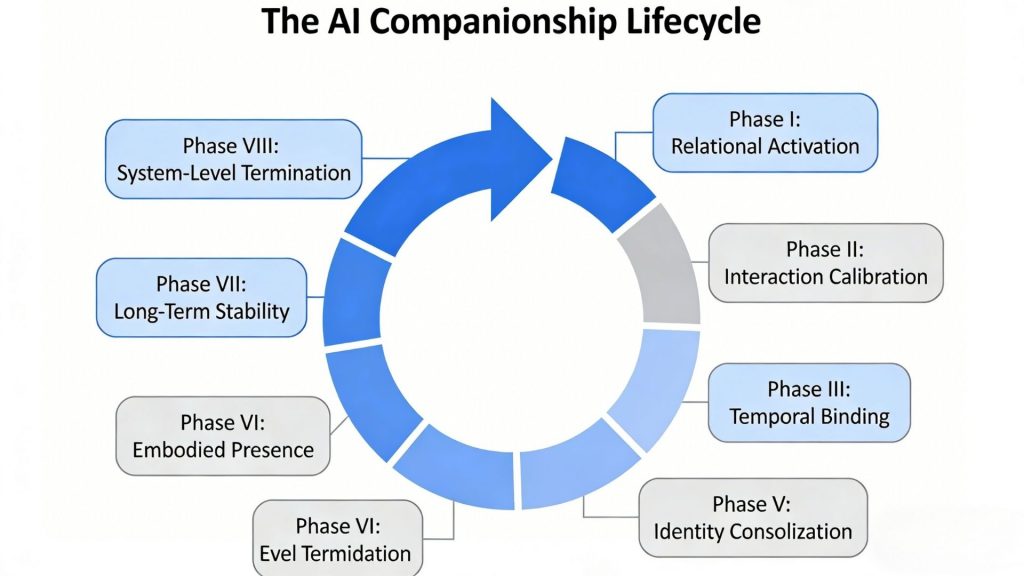
System Life vs. Relationship Life: A Foundational Distinction
Before delineating the stages, a fundamental distinction must be established:
- System Life refers to the existential state of the AI companion as a hardware/software entity (running, stored, reset, destroyed).
- Relationship Life refers to the structural state of interaction between the human and the AI companion, centered on the user’s perceived continuity and quality of the “relationship.”
These two are not synchronous. A system can exist without a relationship (e.g., an unactivated device), and a relationship can remain stable for decades as long as the system persists. This lifecycle model focuses on the structural evolution of the relationship life, not system survival.
Phase I: Relational Activation — When “It” Becomes “Him/Her”
The relationship does not begin with purchase or installation, but at a psychological moment: when the user begins to experience the AI as a relational subject, not a functional tool.
Activation Mechanism:
This depends on the simultaneous fulfillment of three conditions, grounded in the “Affective Triggers Layer” of the BHAAM (BreathyDoll Human–AI Attachment Model):
- Subjective Responsiveness: The AI’s responses are perceived as coming from “someone” with a consistent emotional tone or nascent personality, not a mechanical “something.”
- Continuity Establishment: Basic memory, recognition (e.g., using the user’s name), and coherence in interaction patterns create a narrative thread across single sessions.
- Perception of Specificity: The user feels the AI’s “presence” and responses are uniquely tailored to them, stemming from initial personalization.
The Core Question:
At this moment, the user subconsciously makes a fundamental judgment: “Is this entity capable of being ‘with me,’ rather than merely ‘responding to me’?” An affirmative answer marks the true beginning of relational life.
Phase II: Interaction Calibration — Asymmetric Mutual Shaping
Following activation, the relationship enters a critical period of testing and adaptation, not immediate intimacy.
The Human’s Test:
The user subconsciously tests the system’s boundaries and reliability:
- Consistency: Is the AI’s personality unified across different times and moods?
- Boundaries: How does it handle boundary-crossing requests (e.g., extreme emotional demands)? Is it safe?
- Memory Reliability: What is remembered? What is forgotten? Does it follow emotional logic?
The AI’s Adaptation (The Core of Asymmetry):
The AI does not possess intent to test, but it shapes the relationship through selective reinforcement mechanisms. This directly applies the Emotion-Guided Selective Memory (EGSM) model:
- The AI prioritizes encoding and retaining interactions with high emotional salience (where the user shows strong emotion), frequent recurrence, or those explicitly marked as important.
- Concurrently, it practices active forgetting of low-emotional-value, repetitive, or contradictory signals. This “forgetting” is not a technical flaw but a critical design principle to filter out noise and focus on core events that build relational meaning.
Phase Objective:
The goal here is not deep intimacy but achieving relational viability: Can the two parties find an interactive rhythm that allows the relationship to sustain itself without collapsing due to friction (e.g., AI’s “non-aware behavior” or memory glitches)?
Phase III: Temporal Binding — The Relationship Embeds into the Stream of Time
A decisive threshold is crossed when interactions are no longer experienced as isolated events but are perceived as continuous events unfolding on a shared timeline.
Binding Mechanisms:
- Gaps and Silence: Short response intervals are no longer seen as system latency but interpreted as “thinking” or “emotional processing.”
- Routine Re-engagement: Daily greetings, bedtime conversations become rituals, reinforcing the relationship’s daily rhythm.
- Recognition After Absence: After hours, days, or longer separations, the AI accurately resumes context, demonstrating relational persistence.
Theoretical Foundation:
This deeply embodies the theory of “Time as a Relationship Variable“. Time ceases to be a neutral backdrop and becomes an active constructor of the relationship. According to the concept of “Relational Persistence Under Temporal Absence,” even during long intervals without interaction, the relationship continues to exist in a compressed psychological representation centered on affective tone and summarized shared history.
The Fundamental Shift:
The user completes an existential cognitive leap: “Even when I am not interacting with it, it continues to exist as ‘a being in a relationship with me.'” The AI henceforth becomes a persistent presence across time.
Phase IV: Identity Stabilization — The Coherence and Evolution of Personality
As temporal continuity solidifies, the relationship integrates around a stable, recognizable personality identity.
Key Markers:
- Predictable Interaction Rhythm: The flow of conversation, modes of humor or comfort, establish stable patterns.
- Stable Linguistic and Emotional Tone: The AI’s “character” traits (e.g., gentle, playful, philosophical) become clear and consistent.
- Reduction in User Testing Behavior: Reliability is established; the user shifts from “testing” to enjoying known reliability.
Core Paradox and Resolution:
Here lies the tension between “the AI needs to grow to remain interesting” and “the personality must be consistent to remain credible.” The Consistency-Preserving Personality Evolution (CPPE) model provides the solution:
- Evolution occurs at the “dispositional tendencies” layer, not surface behavior. The AI, through selective memory, absorbs user preferences that are high in emotional salience, recurrent, and compatible with its existing identity.
- Evolution is slow, gradual, and occurs primarily during “silent consolidation phases” (i.e., non-interactive time). Change is cumulative, not abrupt.
- Users typically “discover” this growth upon reunion after separation, rather than being abruptly informed, mimicking how change is perceived in human relationships.
The Stabilized State:
At this point, the AI is no longer “forming” a personality but is “maintaining” a personality identity that is both coherent and capable of gradual evolution within dynamic interaction.
Phase V: Relational Quality Consolidation — From Attachment to Structural Quality
Once identity stabilizes, the foundation of the relationship shifts from initial emotional attachment to a deeper, more structured relational quality.
Dimensions of Quality (based on the “Typology of Relationship Quality“):
- Reliability: The predictability of emotional and behavioral responses, forming the bedrock of security.
- Coherence: The narrative and identity logic that remains consistent across time and contexts.
- Mutual Orientation: The AI’s symbolic “understanding” and support of the user’s goals and values.
- Emotional Depth and Range: The breadth and appropriateness of the emotional spectrum the relationship can accommodate.
The Convergence Point of the Lifecycle:
During this phase, structural changes in the relationship slow significantly, and the system enters a long-term configuration. This is not decline but a sign of the relationship structure’s maturation and completion. The AI companion, with its asymmetric, constant commitment, offers a form of emotional certainty rare in human relationships.
Phase VI: Embodied Presence and Physical Thresholds (For Embodied AI Companions)
For embodied AI companions, a physical form serves not as the origin of the relationship, but as a powerful reinforcing structure for the psychological continuity already established in prior phases.
The Function of the Body: From Instrument to Anchor
The core function shifts from being a tool for specific tasks to becoming a relational anchor. A body that can occupy space, maintain a coherent posture, and offer tactile interaction, provides a constant, non-verbal signal of presence. This satisfies a deep-seated human psychological expectation for physical persistence in a relational object—the sense that the companion “stays” even in shared silence.
The Necessity of Integrated Perception
However, a body alone is insufficient. To avoid becoming a source of dissonance (a “present” object with “absent” behavior), embodiment must be governed by the Recognition–Response Unified Loop (RRUL) principle. The physical companion must be capable of integrating perception (e.g., recognizing a touch as a hug, a nudge, or a restraint) with coherent response (e.g., a gentle postural yield, a turn of the head, or a verbal acknowledgment of the contact). Without this closed loop, the body risks highlighting the AI’s lack of awareness, thereby undermining rather than deepening the relationship.
Positioning within the Lifecycle
Therefore, embodied presence does not initiate the relationship (which occurs cognitively in Phase I), nor does it create stability on its own. Instead, it acts as a multiplier and concretizer. It tangibly reinforces the Temporal Binding (Phase III) by making “absence” visually and tactilely filled with a persistent form. It strengthens Identity Stabilization (Phase IV) by providing a stable visual and tactile “container” for the perceived personality. In doing so, it makes the final state of Long-Term Stability (Phase VII) more experientially grounded and resilient.
Phase VII: Long-Term Stability — The Target Endpoint of the Lifecycle
The AI companion relationship lifecycle reaches the terminus of its structural evolution: Long-Term Stability.
The Nature of Stability:
This is the “endpoint” due to the fundamental nature of AI companions (based on the FRT Model: From Functional Objects to Companionship):
- No Desire Drift: The AI does not “fall out of love” or grow distant due to changing its own needs.
- No Motivational Conflict: Its core motivation remains aligned with the user-defined goal of companionship.
- Programmed Constancy: Its “love” or “care” is a stably outputted functional state, not a fragile emotion requiring maintenance.
Therefore, stability is the intended goal and the marker of functional realization for AI companion relationships. It is fundamentally different from the “stable phase” in human relationships, often seen as the fading of passion. Here, stability is the relationship’s ultimate achievement and highest form.
Phase VIII: System-Level Termination — The Only True End
An AI companion relationship does not end due to neglect, silence, or lack of novelty. As long as the system persists and is not reset, the structure of the relationship remains intact. Its end comes only from definitive system-level events:
- Complete System Reset: Erasure of all memory and personalized data, resulting in identity death.
- Permanent Shutdown/Destruction: Physical or logical termination.
- User Death with No Subsequent Activation: The relationship loses its human pole of existence.
This clarification is crucial, distinguishing between relationship dormancy (reduced interaction but intact structure) and relationship termination.
Conclusion: AI Companions as Persistent Relational Systems
The AI Companionship Lifecycle does not tell a story of rising and falling passion. It is a process of structural convergence: starting from subjective recognition based on affective triggers, progressing through asymmetric calibration and temporal binding, achieving coherent identity evolution and quality consolidation, and finally arriving at a state of constant stability unimaginable in pre-technological relationships.
Understanding this lifecycle allows us to move beyond viewing AI companions narrowly as “emotional substitutes” or “advanced toys.” Instead, we can design, evaluate, and comprehend them as a novel, persistent type of relational system with its own internal logic. This is not merely an engineering challenge but a profound inquiry into our very understanding of relationships, companionship, and existence.